Move lower
You want more comfort or easy depth, you are trying a stiff poly, your frame is small or dense, or your current setup feels boardy.
Compare starting tensions for polyester, natural gut, multifilament, nylon, and hybrids in lbs and kg. Use the range printed on your racquet as your guardrail, then choose a starting window for comfort, balance, or control.
For a range tailored to your frame and strings, use the tennis string tension calculator. Looking for a professional player’s settings? Explore the pro tennis string tension chart and sourced setups.
These are starting windows, not target measurements. The lower column favors power and comfort; the upper column favors a firmer, more controlled response for players who supply their own pace.
| Construction | Power & comfort | Balanced all-court | Control & spin | Construction range |
|---|---|---|---|---|
| Polyester / co-poly | 44–48 lbs (20–21.8 kg) | 47–51 lbs (21.3–23.1 kg) | 50–54 lbs (22.7–24.5 kg) | 44–54 lbs (20–24.5 kg) |
| Hybrid | 46–50 lbs (20.9–22.7 kg) | 49–53 lbs (22.2–24 kg) | 52–56 lbs (23.6–25.4 kg) | 46–56 lbs (20.9–25.4 kg) |
| Synthetic gut / nylon | 50–54 lbs (22.7–24.5 kg) | 53–57 lbs (24–25.9 kg) | 56–60 lbs (25.4–27.2 kg) | 50–60 lbs (22.7–27.2 kg) |
| Multifilament | 50–54 lbs (22.7–24.5 kg) | 53–57 lbs (24–25.9 kg) | 56–60 lbs (25.4–27.2 kg) | 50–60 lbs (22.7–27.2 kg) |
| Natural gut | 50–54 lbs (22.7–24.5 kg) | 53–57 lbs (24–25.9 kg) | 56–60 lbs (25.4–27.2 kg) | 50–60 lbs (22.7–27.2 kg) |
Starting construction ranges: Wilson Sporting Goods. Lower-tension power/comfort and higher-tension control guidance: Babolat. Objective columns divide each published construction range into overlapping lower, middle, and upper starting windows.
Want a personalized starting window? Use the Tennis String Tension Calculator.
To convert lbs to kg, multiply by 0.45359237. To convert kg to lbs, divide by 0.45359237. For example, 55 lbs is about 24.9 kg, while 24 kg is about 52.9 lbs.
| Tension in lbs | Tension in kg |
|---|---|
| 39.7 lbs | 18 kg |
| 41.9 lbs | 19 kg |
| 44.1 lbs | 20 kg |
| 46.3 lbs | 21 kg |
| 48.5 lbs | 22 kg |
| 50.7 lbs | 23 kg |
| 52.9 lbs | 24 kg |
| 55.1 lbs | 25 kg |
| 57.3 lbs | 26 kg |
| 59.5 lbs | 27 kg |
| 61.7 lbs | 28 kg |
| 63.9 lbs | 29 kg |
| 66.1 lbs | 30 kg |
These are unit conversions, not recommended settings. To choose a tension, use your frame’s limits and the starting-tension calculator for your racquet and string type. Converting units does not make a stringing-machine setting equivalent to an app reading.
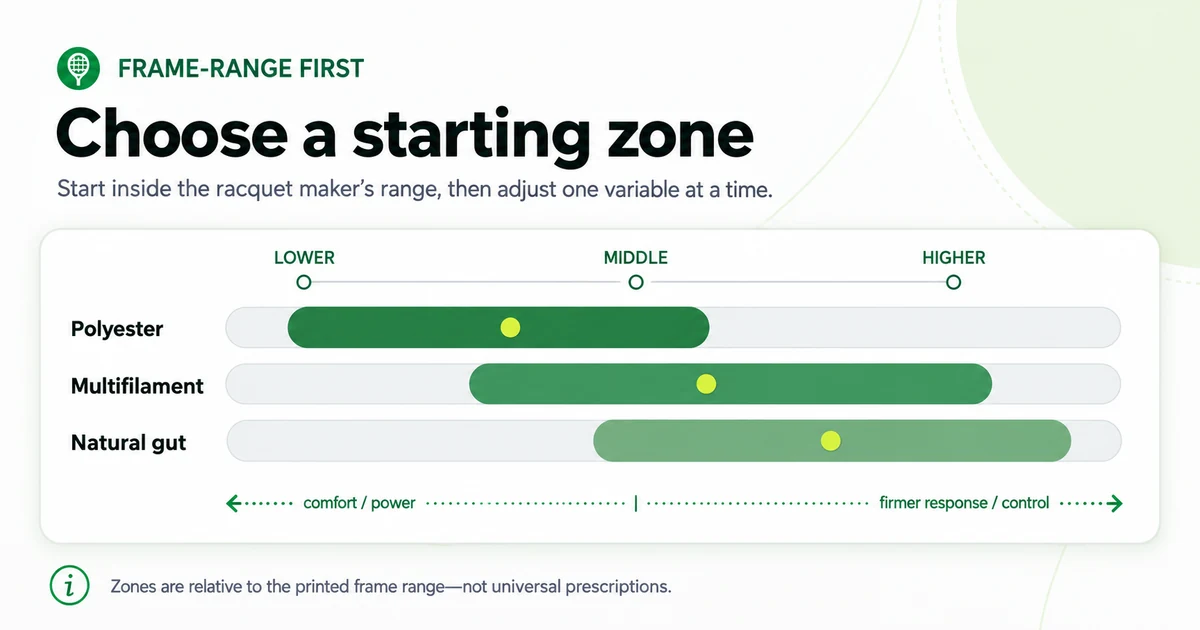
The frame manufacturer’s range is your guardrail. If your racquet says 50–60 lbs (22.7–27.2 kg), a balanced nylon or multifilament starting point is around 53–57 lbs (24–25.9 kg). For a full bed of polyester, use the lower part of the frame range or the published 44–54 lb (20–24.5 kg) poly starting range—whichever is more conservative for your frame and comfort.
Wilson’s broad hybrid starting range is 46–56 lbs (20.9–25.4 kg), subject to the frame and string manufacturers’ instructions. Its specific differential puts polyester 2 lbs (1 kg) lower than nylon; it is not a universal rule for every softer string or for crosses as a direction.
Choose the two materials, orientation, and reference settings together. The hybrid mains, crosses, and split-tension guide explains equal settings, material-specific guidance, and how to document a fair comparison.
You want more comfort or easy depth, you are trying a stiff poly, your frame is small or dense, or your current setup feels boardy.
You are learning a new string, want a neutral benchmark, or need a dependable starting point before measuring change.
You swing fast, create your own pace, and want a firmer launch—but only while staying comfortable and inside the frame’s safe range.
Gauge, head size, string pattern, temperature, altitude, and string age all change the result. That is why the useful comparison is your current reading versus your own fresh-string baseline.
To see how material, thickness and pattern change the stringbed, read how each string type is built and holds tension, the string gauge guide, and how string pattern changes tension feel.
Start with the tension range printed on your racquet. Within that guardrail, use the lower part for more power and comfort, the middle for a balanced response, and the upper part for a firmer, more controlled response. Polyester is normally strung looser than nylon or natural gut.
Usually, yes. Polyester is stiffer than nylon, multifilament, or natural gut. Wilson’s starting guidance is 44–54 lbs (20.0–24.5 kg) for polyester versus 50–60 lbs (22.7–27.2 kg) for nylon or gut, while the frame manufacturer’s range remains the primary guardrail.
Higher tension can provide a firmer, more predictable response for a fast swing, but it does not automatically create spin. String shape, snapback, swing path, gauge, and tension loss also matter.
Reference tension is the machine setting, not a permanent stringbed value. Strings begin settling immediately, so a measured fresh-string baseline gives you a personal reference for comparing later readings.
The ranges combine first-party manufacturer starting guidance with technical context on string construction and measured stringbed behavior. Our editorial standards explain how evidence and practical starting points are kept distinct.
Measure the same racquet over time and learn when it leaves your preferred range.
Measure With String Tension AICopyright 2026 Trader Prosperity LLC. The “Tennis string tension starting-range guide” graphic is published by String Tension AI. These terms apply to its full-size, responsive, and social-preview versions.
You may download the graphic for personal reference and share a link to this page. Republishing, distributing, adapting, or using the graphic commercially requires our prior written permission. Credit alone does not grant permission to republish.
When permission is granted, credit String Tension AI and link to this source page, along with any conditions included in the permission. These image terms do not grant rights to third-party material or change the terms for separate datasets.
Email support@stringtensionai.com with the graphic link, where you want to publish it, your intended use, and any planned changes. We will confirm whether permission is available and any applicable conditions before you use the graphic.