Define your endpoint
Use the first repeatable point where control, comfort, spin, or confidence leaves your acceptable range.
A cheaper string job is not always the cheaper setup. Compare two options using installed cost and the hours they remain playable for you—then see cadence, monthly spend, and annual spend.
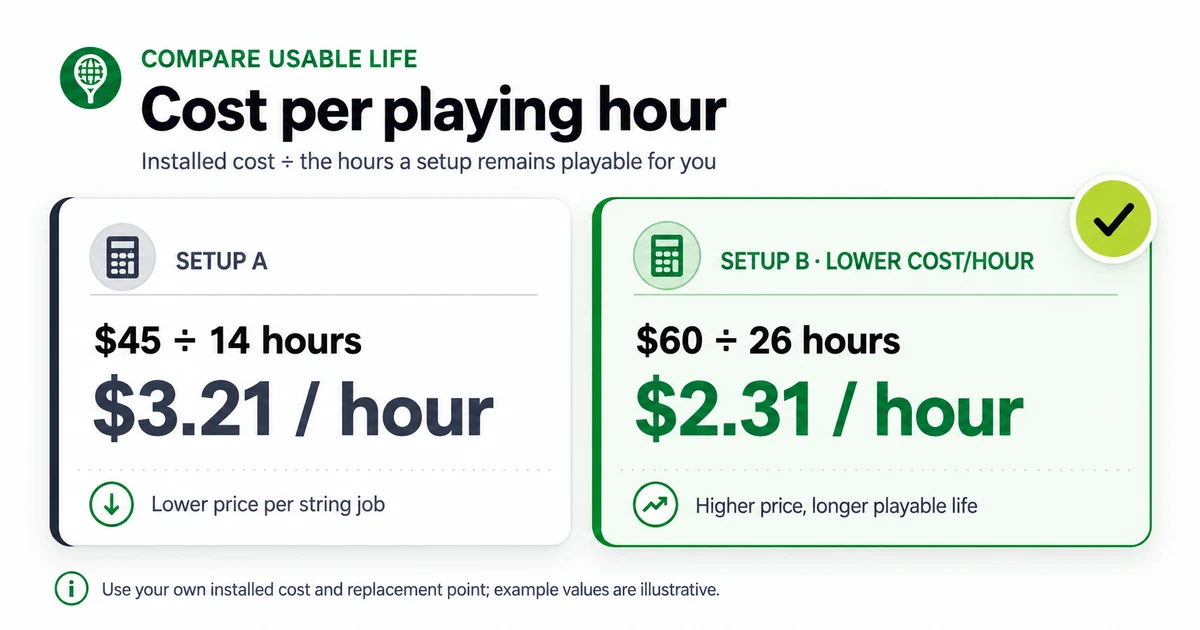
Cost per playing hour = installed string-job cost ÷ playable hours.
If you enter weekly hours, annual cost equals cost per playing hour × weekly hours × 52. Monthly cost is the annual estimate divided by 12. Restring cadence equals playable hours ÷ weekly hours.
The calculation excludes racquet purchase, travel, taxes not included in your input, and the value of unused reel inventory. For a hybrid, itemized mode lets you enter the amount of main and cross string actually used.
This is transparent first-party calculator logic: inputs stay in the browser, each formula is shown above, and the example can be reproduced by hand. See our editorial and correction standards.
Use the first repeatable point where control, comfort, spin, or confidence leaves your acceptable range.
Calendar time can hide large differences between someone playing once a week and someone playing daily.
Installed cost is the fairest comparison. Reel price alone understates each restring if you pay a stringer.
Replace guessed hours with the average from two or three logged string jobs.
Logging hours by hand is the part most players abandon. In the String Tension AI app, playing sessions can be logged in a tap, dictated to Siri, or imported from tennis workouts you already track in Apple Health, and each session is attached to the string job that was in the racquet at the time. Session logging and streaks are free; the cost-per-hour and budget analytics built on top of them are a PRO feature.
Track your setup and tension trend so future cost comparisons use your own evidence.
Track With String Tension AICopyright 2026 Trader Prosperity LLC. The “Tennis string cost per playing hour” graphic is published by String Tension AI. These terms apply to its full-size, responsive, and social-preview versions.
You may download the graphic for personal reference and share a link to this page. Republishing, distributing, adapting, or using the graphic commercially requires our prior written permission. Credit alone does not grant permission to republish.
When permission is granted, credit String Tension AI and link to this source page, along with any conditions included in the permission. These image terms do not grant rights to third-party material or change the terms for separate datasets.
Email support@stringtensionai.com with the graphic link, where you want to publish it, your intended use, and any planned changes. We will confirm whether permission is available and any applicable conditions before you use the graphic.