Strings technical guide
Reports little empirical support for thinner-string spin claims and no appreciable spin difference between rough or smooth, low- or high-tension strings.
Read the ITF PDFSpin tension guide · String Tension AI
Start inside your racquet’s recommended range, then tune for launch, control, comfort, and confidence. Tension alone does not guarantee more RPM.
Evidence-first guidance · lbs primary, kg secondary · No universal “magic number”
There is no single best tennis string tension for spin. The ITF reports no appreciable spin difference between low- and high-tension strings in its technical overview. Start inside the range printed on your racquet, use a string and pattern that let you swing confidently, and tune tension for a usable launch window—not a promised RPM gain. As a practical rule, Wilson recommends stringing polyester about 2 lbs (1 kg) lower than nylon because it is stiffer; change one variable at a time and compare on court.
String tension changes the way a stringbed launches and feels. Spin is more complicated: technique supplies the motion, while string movement, friction, pattern, material, impact location, and tension interact.
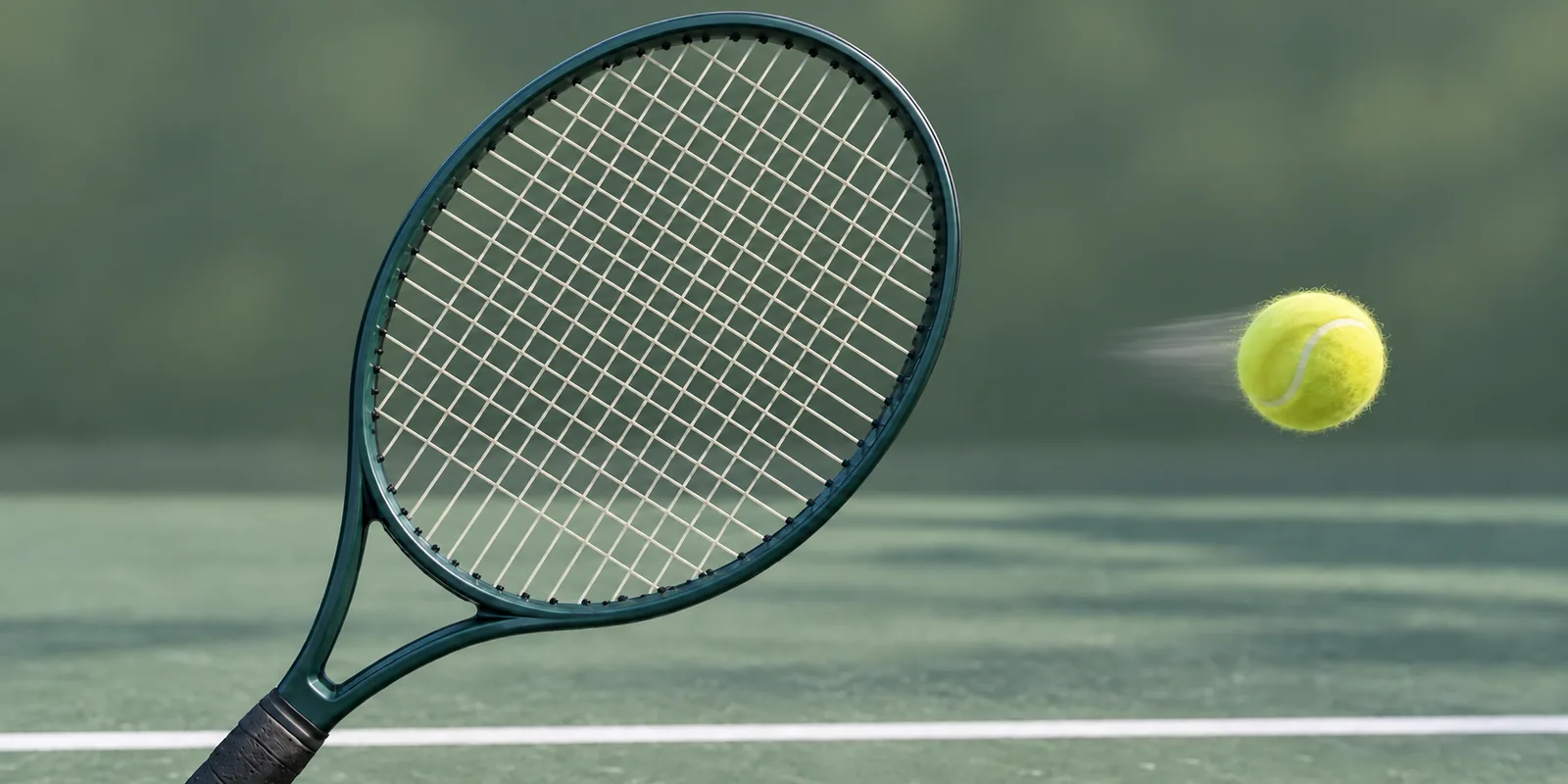
A low-to-high swing path brings the ball into the stringbed.
The mains can bend and move laterally during contact.
Low inter-string friction can help the displaced mains return.
The rebound combines the player’s stroke and the stringbed response.
Evidence summary: the ITF technical string guide reports no appreciable spin difference for low- versus high-tension strings. A controlled 16×19 versus 16×12 study found greater lateral string movement and slightly higher rebound spin with fewer crosses. Those are controlled results, not a guarantee for every player or racquet.
Your racquet frame and string instructions set the boundaries. Inside them, start near a familiar reference and change one variable at a time. A number that supports a confident upward swing is more useful than a supposedly “spinny” number you cannot control.
If spin is not your only goal, the general-purpose tennis string tension calculator turns your frame range and string construction into a starting window.
| String setup | How to start | Spin-focused watchout |
|---|---|---|
| Polyester / co-poly | Stay inside the frame and string ranges. Wilson recommends poly about 2 lbs (1 kg) looser than nylon because it is stiffer. | Poly can support main-string movement, but notching and lost snapback can change the response before the string breaks. |
| Hybrid | Follow the instructions for both strings and tell the stringer which material is in the mains and crosses. | The mains usually dominate feel and movement. Record both reference tensions, not one blended number. |
| Multifilament or synthetic gut | Begin inside the frame range at a tension you already control, then tune launch and depth in a small step. | Comfort and power can help you swing freely, but surface wear and friction may limit easy snapback. |
| Natural gut | Use the racquet and string guidance, accounting for whether gut is used as a full bed, main, or cross. | Gut holds tension well, but moisture, notching, and the hybrid partner can change the result. |
Neither column guarantees more spin. The useful tension is the one that lets you swing up and through the ball with repeatable depth and confidence.
Enter the range printed on your frame, then describe the result you get now. The tool suggests a small, reversible test—not a universal optimum or an RPM prediction.
Track My Racquet Free
Spin setup advice becomes useful only when you can compare it. Keep everything else steady, make one small change, and judge the result across more than a few perfect or imperfect shots.
Use the same frame, string model, gauge, stringer, and stringing method.
A small step is easier to interpret and reverse than a complete setup overhaul.
Hit serves, returns, neutral rallies, defensive balls, and attacking forehands.
Record launch, depth, comfort, control, confidence, and the tension reading.
Do not change string model, gauge, and tension at the same time. If the result improves or worsens, you will not know which variable caused it.
Laboratory work isolates variables. Real strokes add changing swing speed, impact location, incoming spin, strings, wear, weather, and human adaptation. This guide uses research to rule out simplistic claims, then recommends a personal, repeatable test.
Reports little empirical support for thinner-string spin claims and no appreciable spin difference between rough or smooth, low- or high-tension strings.
Read the ITF PDFA fixed-racquet study compared 16×19 and 16×12 beds at 30 m/s and connected greater lateral main-string movement with slightly higher rebound spin.
Read the open paperAmong 48, 54, and 60 lbs in 15 male athletes, the middle condition led the tested ball-speed and control results. Spin was not measured.
Read the peer-reviewed studyDefines the common power-control tradeoff and advises polyester about 2 lbs (1 kg) looser than nylon because the material is stiffer.
Read Wilson’s guideReviewed August 9, 2026. The interactive guide uses transparent decision rules: a high launch suggests testing up to 2 lbs higher, short depth or discomfort suggests testing up to 2 lbs lower, and a controlled response suggests holding the number steady. Results are clamped to the frame range entered by the user. These are experiment prompts, not performance predictions.
Not automatically. The ITF’s technical string guide reports no appreciable difference in spin between low- and high-tension strings. Lower tension can change launch, depth, feel, and string movement, but usable spin still depends on swing path, racquet-head speed, string behavior, pattern, and contact.
Start inside the range printed on your racquet and follow the string maker’s instructions. Wilson advises stringing polyester about 2 lbs (0.9 kg) looser than nylon because polyester is stiffer. Treat that as a starting comparison, not a promise of more spin.
50 lbs (22.7 kg) can be reasonable if it falls inside your racquet and string manufacturers’ recommended ranges and suits your response goals. The number is not a spin score. Compare launch, depth, comfort, control, and confidence with the same racquet and string before deciding.
An open pattern can allow more main-string movement than a denser pattern, but racquets and patterns differ. A controlled study comparing 16×19 and 16×12 stringbeds found slightly higher rebound spin with fewer crosses; that does not mean every open-pattern racquet will outperform every dense one.
No. A professional’s number belongs to a specific racquet, string or hybrid, gauge, machine, stringer, conditions, swing, and preference. Use pro setups as research context, then begin inside your own frame’s range and test with your own game.
Keep the same racquet, string model, gauge, and stringer. Change only the reference tension, play a full session, and log launch, depth, comfort, control, and confidence. Repeat before deciding; one great or difficult hitting day is weak evidence.
Measure the same racquet over time, keep useful notes, and turn every restring into a better test.
Download String Tension AI FreeCopyright 2026 Trader Prosperity LLC. The “Tennis stringbed and spinning ball” graphic is published by String Tension AI. These terms apply to its full-size, responsive, and social-preview versions.
You may download the graphic for personal reference and share a link to this page. Republishing, distributing, adapting, or using the graphic commercially requires our prior written permission. Credit alone does not grant permission to republish.
When permission is granted, credit String Tension AI and link to this source page, along with any conditions included in the permission. These image terms do not grant rights to third-party material or change the terms for separate datasets.
Email support@stringtensionai.com with the graphic link, where you want to publish it, your intended use, and any planned changes. We will confirm whether permission is available and any applicable conditions before you use the graphic.